
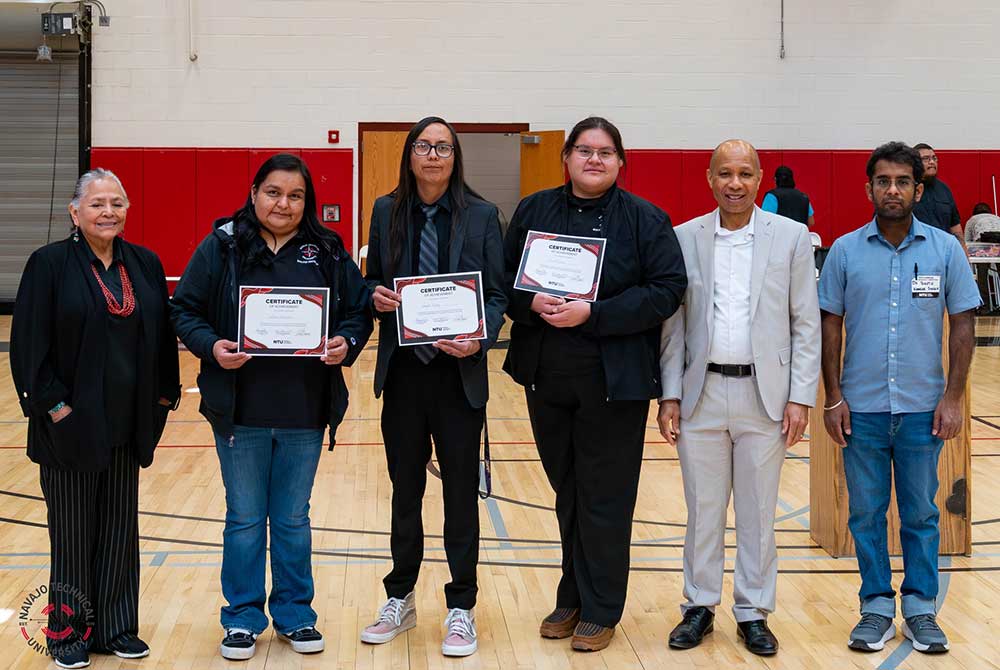
A panel of five university officials judged the submissions based on the thoroughness of their analysis, their overall impact, and the organization of the subject matter, with cash prizes awarded to the top three winners.
First Place went to Wayant Billie, taking home the top prize for his project, “Fabrication of Laser-Induced Graphene-Based Electrochemical Sensors for Heavy Metal Detection and Environmental Monitoring.” Driven by the need for clean water, Billie developed small, low-cost, portable sensors based on laser-induced graphene (LIG). Wayant hopes these innovative devices can quickly detect harmful metals on-site, providing a practical, affordable tool for monitoring metal contamination throughout the Navajo Nation.
Latasha Chiquito secured second place with her project, “Hydroponic Farming: An Innovative Approach to Sustainable Leafy Greens in Controlled Water Environment.” Her research focuses on implementing hydroponic systems, specifically the Nutrient Film Technique (NFT) and Deep-Water Culture (DWC), to increase local access to fresh produce. The project has already established two hydroponic greenhouses at the Mariano Lake Chapter House and the NTU Main Campus in Crownpoint, NM. Latasha plans to expand the cultivation of other crops, such as squash, broccoli, and cauliflower, for community distribution.
David Willie placed third for the biological research project, “Uranium Tailings and its Potential Influence on Antimicrobial Resistance to Available Clinical Antibiotics.” Willie tested sites around NTU, including Nahodishgish, West Mesa, and Rocky Road, which were selected based on past reports of high Uranium (U) readings. The study investigates the potential interference of uranium radiation with the effectiveness of clinical antibiotics. David is aiming to shed light on a possible link between uranium exposure and the development of Antimicrobial Resistance (AMR), which can cause bacterial mutations.
“You have prepared your materials, received professional feedback, and identified your mentor. Congratulations to all who showcased their research and work,” Casmir stated.
The prizes for the best three posters are:
1st Place – Wayant Billey
Fabrication of Laser-Induced Graphene-Based Electrochemical Sensors for Heavy Metal Detection and Environmental Monitoring
2nd Place – Latasha Chiquito
Hydroponic Farming: An Innovative Approach to Sustainable Leafy Greens in Controlled Water Environment
3rd Place – David Willie
Uranium Tailings and Their Potential Influence on Antimicrobial Resistance to Available Clinical Antibiotics
Casmir I. Agbaraji, Ph.D.
Dean of Undergraduate Studies
Navajo Technical University
P: 505-387-7371
E: cagbaraji@navajotech.edu